
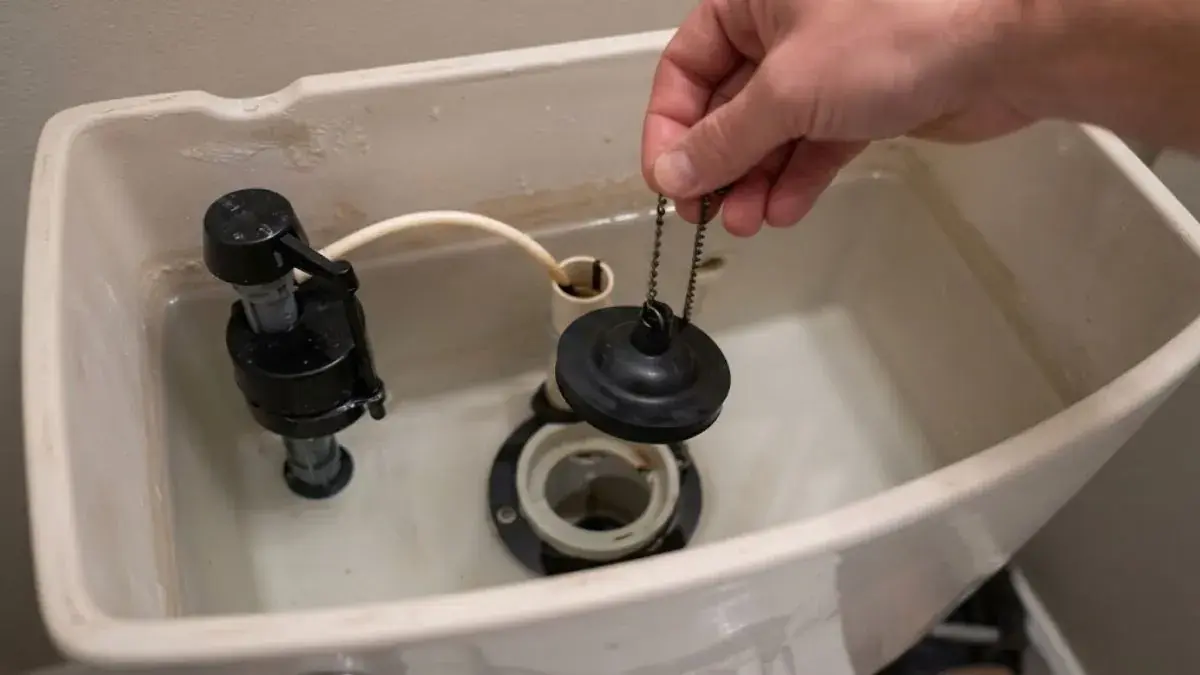
How A Toilet Tank Works
When you flush, the tank empties into the bowl through a rubber flapper at the bottom. A float then lets the fill valve refill the tank, and the flapper reseats. If the flapper does not seal, water leaks slowly into the bowl and the fill valve keeps running to refill the tank.
Most running toilets come down to the flapper, the fill valve, the float or the overflow tube. Take the tank lid off and watch what happens.
The Usual Causes
| Cause | Clue | Fix |
|---|---|---|
| Worn flapper | Water trickles into the bowl, ghost flushes | Replace flapper |
| Chain too tight or long | Flapper does not seat | Adjust chain |
| Float set too high | Water spills into the overflow tube | Lower float |
| Worn fill valve | Hissing or constant refill | Replace fill valve |
| Cracked overflow tube | Water level drops with no flush | Replace the parts |
Toilet Won't Stop?
Shut the valve behind it and call.
Parts Are Easy To Find
Flappers and fill valves are sold at hardware stores in the Maywood area. Take the old part with you or note the make of the toilet from the tank so you buy the right fit.
If you rent, tell the landlord before replacing parts, since many leases require repairs to go through them.
We take calls from South Gate and Commerce as well, so the steps here apply there too.
Steps To Try
- Add food coloring to the tank. If color shows in the bowl, the flapper leaks.
- Check the chain between the handle and the flapper. It needs a little slack.
- Lower the float so the water stops about an inch below the overflow tube.
- Press the flapper down by hand. If the running stops, replace the flapper.
- If the fill valve hisses and never shuts off, replace it.
Turn off the small valve behind the toilet if you need to stop the water while you work.
When It Is A Bigger Problem
A toilet that rocks, leaks at the base or clogs repeatedly is a different problem. A leak at the base can mean a failed wax ring, and water can damage the floor. A repeat clog may point to a drain issue beyond the toilet. Read toilet repair and installation for those cases.
If the toilet is old and keeps needing parts, replacing it can be cheaper than repairs.
Why It Matters For Your Bill
A leaking flapper may not be noticeable and can run day and night. It is one of the most common causes of a high bill. If you are chasing a high bill, follow the steps in our leak detection guide, which starts with a meter test.
Replacing A Flapper Step By Step
Turn off the supply valve behind the toilet and flush to empty the tank. Unhook the chain and lift the old flapper off its pegs. Clean the valve seat with a cloth, since grit stops a new flapper from sealing.
Fit the new flapper on the pegs, connect the chain with a little slack, and turn the water on. Flush and watch the tank refill. Repeat the dye test to confirm the leak has stopped. The whole job takes about fifteen minutes.
Replacing A Fill Valve
A fill valve that hisses, never shuts off or fills slowly is worn. Turn off the supply, empty the tank, disconnect the supply line and remove the old valve by loosening the nut under the tank. Install the new valve at the height shown on its packaging, tighten the nut by hand plus a little more, and reconnect the supply.
Set the water level a bit below the top of the overflow tube. Flush a few times to check for leaks at the nut.
Signs You Need A Plumber
Call a plumber if water is leaking at the base, if the tank bolts leak, if the toilet rocks, or if the supply valve will not turn. These problems can damage subfloors, and a failed wax ring can hide a slow leak for months.
Also call if a new flapper and fill valve do not stop the running. The problem may be a cracked tank or a worn seat, which is a replacement rather than a repair.
Choosing A Replacement Toilet
If you decide to replace the toilet, look at flush volume, bowl shape and rough-in distance, which is the gap from the wall to the drain center. Most homes use a twelve inch rough-in, and measuring first avoids a return trip.
A taller bowl suits some users, and a one-piece design is easier to clean. Ask the plumber what fits your space. See toilet repair and installation for the full process.
Water Savings From A Quick Repair
A toilet that runs on can waste water all day. Fixing it takes minutes with a ten dollar part, and the savings show up on the next bill. If the toilet was the cause of a high bill, the fix pays for itself fast.
Check every toilet in the house once a year with the dye test. It takes five minutes per toilet and finds leaks before they grow.
Tools And Parts List
Gather a bucket, a sponge, an adjustable wrench, a flapper and a fill valve of the right type, and a few rags. Take a photo of the inside of the tank before you start, so you can match the parts. Have the shutoff valve working before you begin, since a stuck valve is the most common reason a simple job becomes a call to a plumber.
If the shutoff valve is stuck or leaks when turned, replace it first. It is a small part that protects the whole house later.
Rinse the new parts and your hands when done. Replacement takes no special skills, only care.
California standards limit flush volume on new toilets, and the California Plumbing Code, based on the Uniform Plumbing Code (UPC), sets how a toilet connects to the drain.
Questions We Hear
It mostly wastes water. It can also hide a bigger problem, so check it soon.
Check the make and model on the tank or compare to the old flapper. Many are universal.
That is often called a ghost flush and points to a slow flapper leak.
If the toilet is old and has several problems, replacing it can be cheaper than repeated repairs.
Yes. A toilet that will not stop filling or leaks across the floor is an emergency.